Keeping track of tools, equipment, materials, pallets, and other assets becomes difficult when items constantly move across different areas of a facility. Manual identification can make it harder to maintain accurate movement records and know where an asset was last detected.
An RFID Tracking System automates this process by giving assets unique RFID identities and capturing their movements through RFID readers. But what actually happens when an RFID-tagged asset moves through a facility? The process involves tagging, detection, data capture, processing, and recording the resulting movement event.
What Components Make RFID Asset Tracking Possible?
An RFID asset tracking setup typically brings together four key elements:
- RFID Tags: Attached to assets and associated with their unique identification information.
- RFID Readers: Detect and capture information from RFID tags within their reading area.
- Antennas: Help establish the area in which tags can be detected by the reader.
- Tracking Software: Receives the captured information and connects it with the corresponding asset and operational event.
Together, these components turn the movement of a physical asset into trackable digital information.
How Does an RFID Asset Tracking System Work?
The working process of an RFID Tracking System follows a continuous flow from the physical asset to the tracking software. RFID tags identify individual assets, readers capture their information, and connected software converts those detections into useful tracking records. This enables automated asset tracking across different operational points.
1. An RFID Tag Is Assigned to the Asset
The process begins with attaching an RFID tag to the asset that needs to be monitored. Depending on the application, this could be a tool, fixture, equipment item, pallet, carton, material, or finished good.
Each tag provides a unique identification that can be associated with the corresponding asset in the tracking software. This creates a digital connection between the physical item and its information, forming the foundation of RFID asset tracking.
2. The RFID Reader Detects the Tag
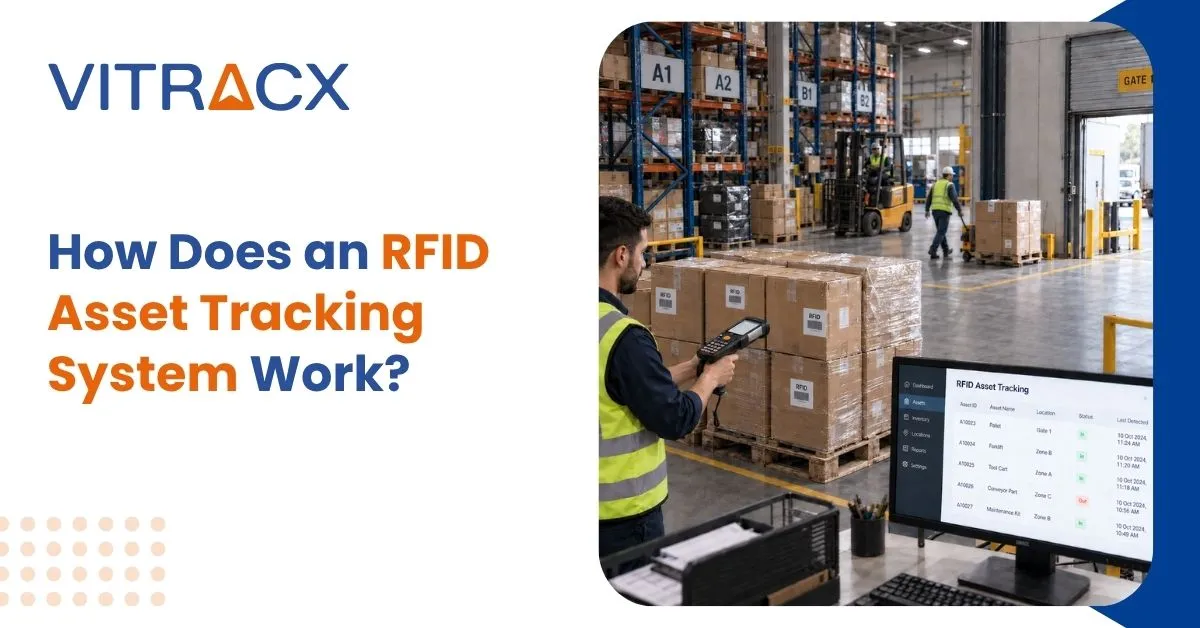
When a tagged asset enters the detection area of an RFID reader, the reader captures the identification information from the tag through radio frequency communication.
This enables automated RFID data capture without requiring an operator to manually scan each item. Unlike traditional barcode-based identification, RFID can detect tagged items without requiring direct line-of-sight between the tag and reader.
This makes RFID particularly useful where assets and materials are continuously moving through operational areas.
3. The Reader Captures the Asset Information
After detecting the tag, the RFID reader captures its unique identification data. Readers can be positioned at defined tracking points such as gates, dock doors, receiving areas, storage zones, production points, or dispatch locations.
When the same tagged asset passes through different reading points, each detection can generate another movement record. This allows an RFID Tracking System to build a more consistent history of asset movement across the workflow.
4. The Data Reaches the Tracking Software
The information captured by the RFID reader is transmitted to the connected tracking software. The system uses the tag’s unique identity to determine which asset has been detected.
The software can then associate the detection with the relevant location, checkpoint, or operational event. This converts individual RFID reads into useful asset tracking data, reducing dependence on manually maintained movement records.
5. Asset Movement Becomes Traceable
As an asset is detected at successive RFID reading points, organizations can build a digital history of its movement through the facility.
For example, a tagged asset may first be detected in receiving, later identified in storage, and then recorded when it moves toward production or dispatch. These successive detections provide greater asset movement tracking and help teams understand how assets move through defined operational stages.
This is where RFID moves beyond simple identification. By connecting tag detections with software, RFID asset management can provide a clearer digital record of where assets have been detected throughout their workflow.