Skip to content
UWB Tracking System Explained: How Ultra-Wideband Enables Precise Indoor Positioning

Locating equipment, tools, and work-in-progress (WIP) materials across large industrial facilities can be challenging when visibility depends on manual searches or periodic inventory checks. Indoor positioning technology helps businesses identify where tagged assets are located and understand how they move across production and storage areas.

A UWB Tracking System uses Ultra-Wideband radio technology to calculate indoor positions through precise timing measurements. When connected to tracking software, it can provide real-time location views, movement history, and configured alerts, helping industrial teams improve asset visibility and coordinate operations more effectively.

What Is a UWB Tracking System?

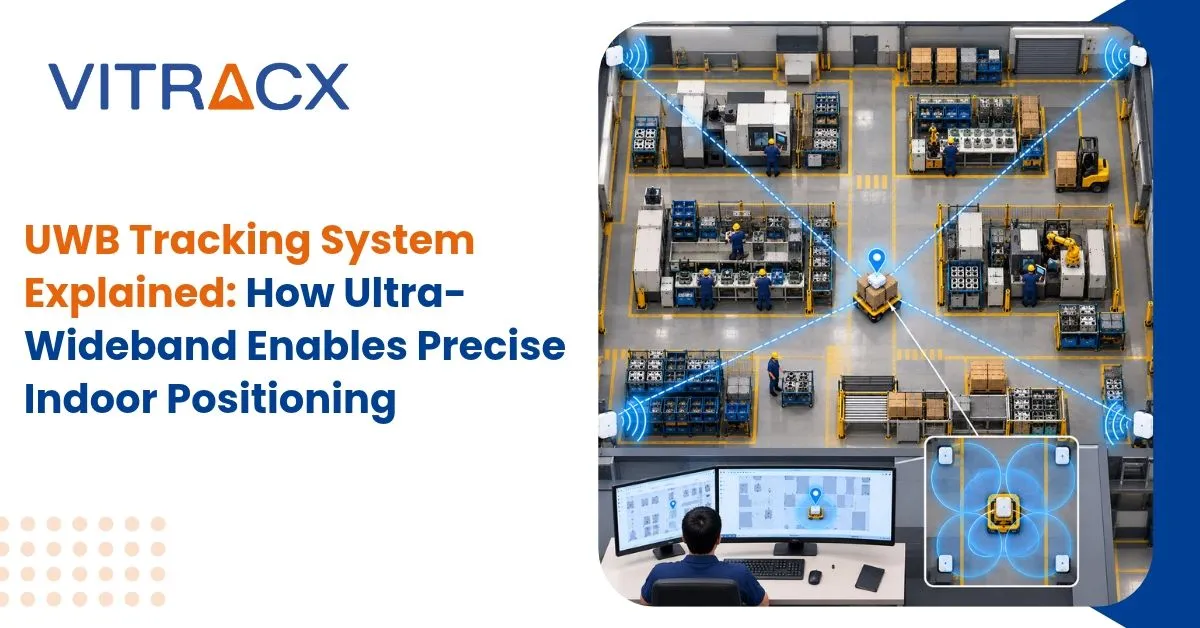
Ultra-Wideband (UWB) is a wireless technology that transmits very short radio pulses across a wide frequency spectrum. Unlike systems that rely mainly on signal strength to estimate proximity, UWB positioning can use the timing of radio signals to calculate the distance between devices and determine a tagged asset’s position.

A typical system includes:

  • UWB tags: Attached to assets, equipment, or other items that need tracking.
  • Anchors: Fixed devices installed at selected locations to receive tag signals.
  • Positioning engine: Processes signal measurements to estimate tag locations.
  • Tracking software: Displays locations on a digital map and presents movement data or configured alerts.

System performance depends on the facility layout, anchor placement, environmental conditions, and deployment design.

How UWB Enables Precise Indoor Positioning?

A UWB Tracking System determines location by measuring the timing characteristics of radio signals exchanged between tags and anchors. Two common positioning techniques are Time of Flight (ToF) and Time Difference of Arrival (TDoA).

With ToF, the system estimates distance using the time a signal takes to travel between devices. With TDoA, it compares the arrival times of signals at multiple synchronized anchors to help calculate the tag’s position.

The positioning engine processes these measurements and estimates the tag’s location within the covered area. The result can be displayed on a digital facility map, allowing teams to check reported asset positions and review movement history. Actual accuracy varies according to system configuration, infrastructure, and site conditions.

Want to improve asset visibility with precise indoor positioning? Contact Us to explore UWB Tracking solutions for manufacturing and industrial facilities.

Key Industrial Applications of UWB Tracking

1. Equipment and Asset Tracking

Forklifts, trolleys, tools, and other mobile resources frequently move between production zones. A UWB Tracking System helps teams locate tagged equipment and understand where resources are being used, potentially reducing time spent searching for available assets.

2. Work-in-Progress Tracking

Manufacturing materials may pass through multiple processing, assembly, inspection, and storage stages. Tracking tagged bins, pallets, or semi-finished products can improve visibility into their reported locations and help teams investigate unexpected waiting periods.

3. Movement and Workflow Analysis

Location history can reveal movement paths, repeated trips, and extended dwell times. Reviewing UWB Tracking System data alongside production information helps teams investigate potential bottlenecks and identify opportunities to improve material flow.

4. Zone Monitoring and Alerts

Tracking software can support configured geofencing alerts when tagged assets enter or leave designated areas. With UWB Tracking System, dashboards can also display movement history and location-based activity, helping teams monitor asset movements and improve operational awareness across industrial facilities.

Benefits of Using UWB for Indoor Tracking

A properly designed UWB Tracking System can offer several operational advantages:

  • Precise positioning: Supports applications requiring more detailed indoor location information than basic proximity detection.
  • Improved asset visibility: Helps teams locate tagged equipment and materials across covered areas.
  • Better coordination: Gives operators and supervisors location information to support resource allocation.
  • Movement insights: Helps teams review travel patterns and investigate delays.
  • System integration: Location data can be connected with manufacturing execution systems (MES), enterprise resource planning (ERP), or warehouse management systems (WMS), depending on compatibility.

These benefits depend on how the system is deployed and how teams use the resulting information.

What to Consider Before Implementation?

Before selecting a UWB solution, businesses should assess the required positioning accuracy, facility dimensions, machinery and metal structures, anchor placement, and the types of assets to be tracked. They should also consider tag battery life, coverage requirements, integration needs, and future expansion.

A site assessment helps determine whether UWB is appropriate for the application and what infrastructure is needed. Testing in the actual operating environment is important because physical obstructions and installation conditions can affect positioning performance.

Frequently Asked Questions

A UWB Tracking System uses Ultra-Wideband radio signals and timing measurements to estimate the indoor positions of tagged assets, equipment, or other tracked items.

It measures signal timing between tags and anchors using techniques such as Time of Flight or Time Difference of Arrival. Software processes these measurements to estimate the tag’s location.

Common applications include tracking mobile equipment, locating WIP materials, reviewing asset movement, and monitoring designated zones across production and storage areas.

UWB is often suitable for applications requiring high-precision positioning, while BLE can support proximity detection and indoor positioning depending on its implementation. The better choice depends on the accuracy, coverage, and operating requirements.

Depending on the platform and available interfaces, UWB location data can integrate with MES, ERP, and WMS systems to connect asset positions with production or inventory information.

Conclusion

Ultra-Wideband technology enables indoor positioning by using radio-signal timing measurements to estimate the locations of tagged assets. A well-planned UWB Tracking System can help industrial teams locate equipment, improve WIP visibility, review movement patterns, and investigate operational delays. Assessing facility conditions, positioning requirements, and integration needs is essential to selecting a solution that supports practical business goals.

Kunj Patel is Co-Founder & CGO at Vitracx, where he designs and scopes RTLS solutions for manufacturing, warehouse, and healthcare clients — turning shop-floor tracking challenges into working systems. He writes about solutioning for Industry 4.0 and real-time visibility.

Back To Top