Skip to content
BLE Tracking System for Equipment Tracking: Reducing Asset Loss and Optimizing Utilization

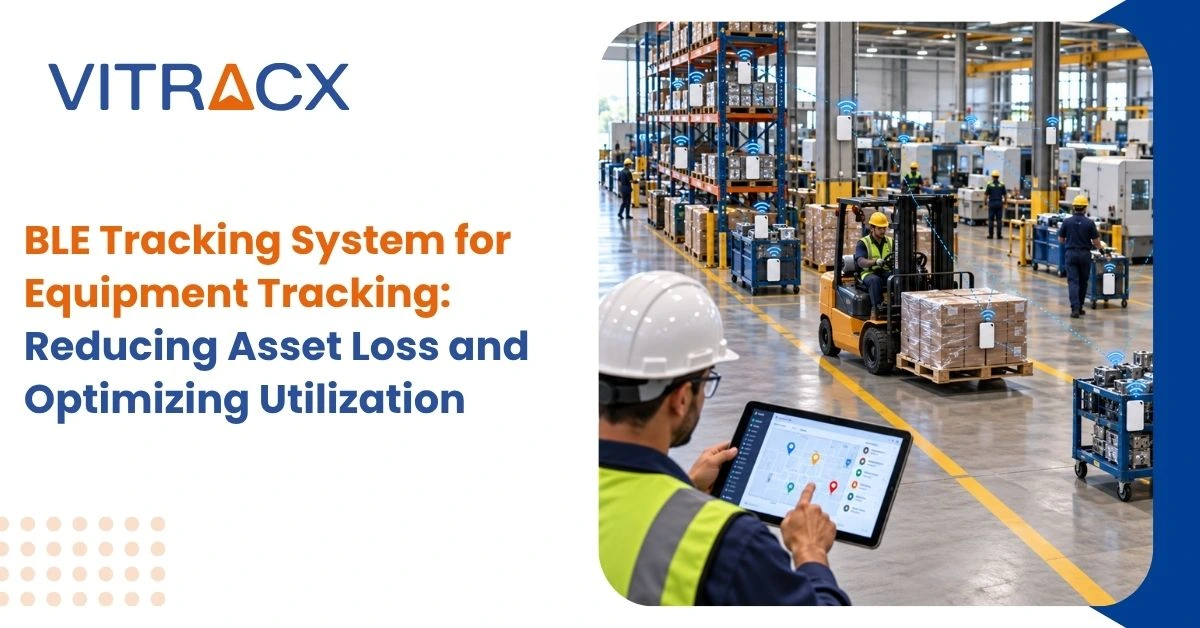
Manufacturing plants and warehouses rely on equipment such as forklifts, tools, trolleys, and other mobile assets to keep daily operations running smoothly. When these resources are difficult to locate, employees waste time searching, workstations may experience delays, and equipment can remain unused despite being needed elsewhere. A BLE Tracking System helps businesses improve equipment visibility by using Bluetooth Low Energy tags and gateways to identify asset locations. With real-time tracking information, organizations can reduce asset search time, understand equipment movement, and make better use of available resources.

How a BLE Tracking System Tracks Equipment?

Bluetooth Low Energy (BLE) is a wireless technology designed for communication with relatively low power consumption. In an equipment tracking setup, BLE tags are attached to selected assets and broadcast signals at configured intervals. Gateways or locators receive these signals, and a tracking platform processes the information to provide location visibility.

Two common BLE positioning approaches support different operational needs:

  • BLE AoA (Angle of Arrival): Uses antenna arrays to estimate the direction of incoming signals, supporting more precise indoor positioning.
  • BLE RSSI (Received Signal Strength Indicator): Uses signal strength to estimate proximity or approximate location, making it useful for room-level or zone-level tracking.

Choosing the right BLE Tracking System depends on the required accuracy, facility layout, and equipment tracking objectives. By selecting the appropriate positioning method, businesses can improve asset visibility and help employees locate equipment more efficiently.

Reducing Equipment Loss and Search Time

When equipment moves frequently between workstations, storage areas, and production zones, manually checking its last known location can interrupt operations. A BLE Tracking System helps employees identify where tagged equipment is detected without searching the entire facility.

For example, if a maintenance team needs a specific tool or a warehouse operator requires a pallet trolley, location information can help narrow the search to the relevant area. Movement history can also support investigations when equipment is misplaced or unexpectedly moved.

Tracking does not automatically prevent every instance of asset loss. However, improved location visibility, movement records, and configured alerts can help organizations manage equipment more systematically and reduce avoidable search time.

Want to reduce equipment search time and improve asset utilization? Contact Us to explore BLE-based tracking solutions for industrial operations.

Optimizing Equipment Utilization

Equipment availability does not always mean equipment is being used effectively. Some assets may remain idle in one area while another department waits for similar resources. Without reliable information about equipment movement and activity, managers may struggle to understand these patterns.

A BLE Tracking System can help teams review location history and equipment movement to identify potential utilization issues. Depending on the tracking setup and available data, businesses can use this information to:

  • Identify assets that remain in particular zones for extended periods.
  • Understand movement patterns between workstations and departments.
  • Locate available equipment before requesting additional resources.
  • Review equipment distribution and support better allocation decisions.

These insights can help improve coordination and make existing equipment easier to manage. Location data alone, however, does not confirm whether an asset is actively operating; additional status or usage data may be needed.

Improving Visibility Across Industrial Facilities

BLE equipment tracking can support manufacturing plants, warehouses, distribution centres, and other facilities where mobile assets move between different areas. Tagged equipment can include tools, forklifts, trolleys, work-in-progress materials, and selected fixed assets.

A connected tracking platform can display asset locations, provide movement history, and support configured zone-based alerts. Depending on the solution, tracking data can also integrate with operational systems to help teams connect equipment visibility with broader workflows.

By selecting the appropriate BLE positioning method, businesses can balance location accuracy, deployment requirements, and cost. This makes a BLE Tracking System suitable for applications ranging from approximate zone visibility to more precise indoor positioning.

Frequently Asked Questions

It is a tracking solution that uses Bluetooth Low Energy tags, receiving infrastructure, and software to provide location visibility for tagged equipment and assets.

BLE tracking helps teams locate tagged assets, review movement history, and use configured alerts to improve visibility when equipment moves between designated areas.

BLE AoA estimates signal direction using antenna arrays for more precise positioning, while BLE RSSI estimates proximity or approximate location using received signal strength.

Yes. Location data and movement history can help identify equipment distribution patterns, locate available assets, and investigate potential underutilization.

Depending on tag suitability and deployment requirements, BLE can track tools, forklifts, trolleys, work-in-progress materials, and other selected industrial assets.

Conclusion

A BLE Tracking System gives manufacturers and warehouse operators better visibility into the location and movement of equipment. By helping employees find assets, reviewing movement patterns, and supporting utilization analysis, BLE tracking can reduce avoidable searching and improve resource coordination. Selecting the appropriate positioning method and integrating tracking data with operational workflows helps businesses build a more organized and efficient equipment management process.

Kunj Patel is Co-Founder & CGO at Vitracx, where he designs and scopes RTLS solutions for manufacturing, warehouse, and healthcare clients — turning shop-floor tracking challenges into working systems. He writes about solutioning for Industry 4.0 and real-time visibility.

Back To Top
WhatsApp chat