Skip to content
UWB Tracking System for MHE Tracking: Real-Time Visibility for Material Handling Equipment

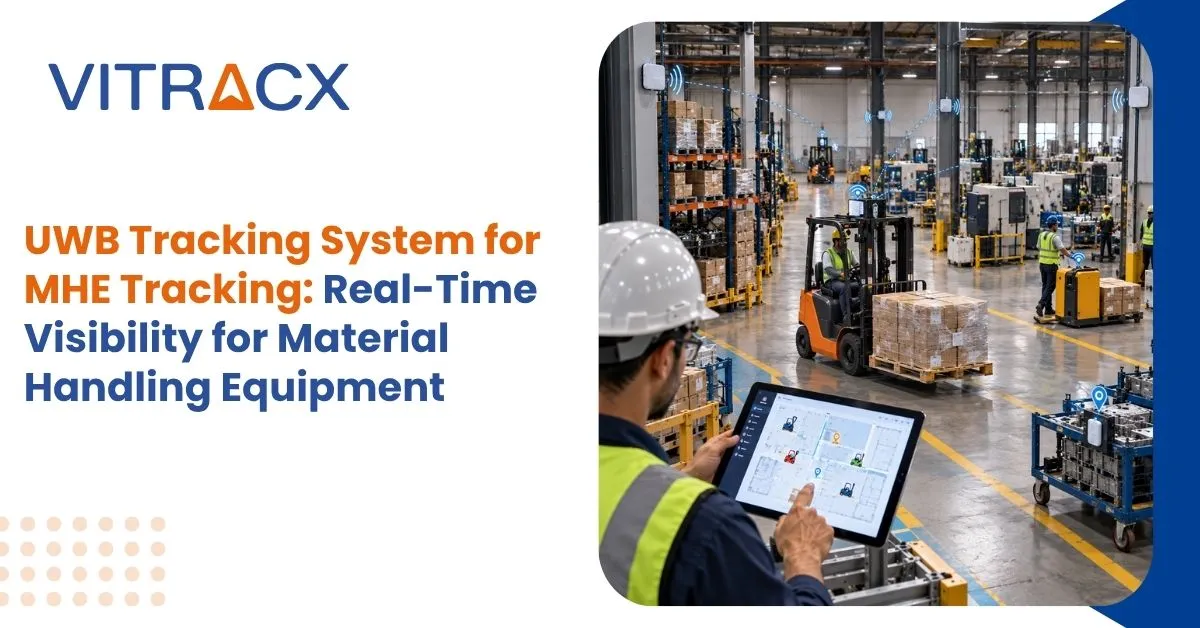
Material handling equipment (MHE) such as forklifts, pallet movers, tuggers, and other internal vehicles constantly move across factories and warehouses. Without accurate location visibility, operators may spend time searching for available equipment, while unnecessary travel and idle time can affect material movement. A UWB Tracking System provides precise real-time positioning to help organizations monitor MHE movement across defined operational areas.

Why Use UWB for MHE Tracking?

UWB is designed for high-precision indoor positioning. This makes a UWB Tracking System useful in environments where knowing the location of an MHE accurately is important, particularly across manufacturing floors, assembly lines, and metal-rich industrial areas.

Unlike a basic location check, UWB can provide frequent positioning updates for moving equipment. This helps operations teams understand where equipment is located and how it moves through the facility.

How Does a UWB Tracking System Work for MHE?

A UWB Tracking System uses UWB tags installed on MHE and anchors positioned at defined locations across the facility. The tags transmit short-duration radio pulses, which are received by multiple anchors or gateways.

The system measures these signals using positioning techniques such as Time of Flight (ToF) or Time Difference of Arrival (TDoA) to calculate the equipment’s position. This location data provides real-time visibility of tracked MHE and helps organizations monitor equipment movement across operational areas.

What MHE Can Be Tracked?

A UWB Tracking System can be used for different types of material handling equipment, depending on the deployment requirements. The supplied Vitracx MHE solution includes:

  • Forklifts and counterbalance trucks
  • AGVs and autonomous mobile robots
  • Reach trucks and order pickers
  • Tuggers and tow tractors
  • Pallet movers
  • Cranes

This allows organizations to bring multiple types of equipment into a connected location-tracking environment.

How Does UWB Improve MHE Visibility?

Knowing the current location of equipment can help teams coordinate material movement more effectively. A UWB Tracking System can provide live positioning information, allowing operators and managers to identify where equipment is operating across the facility.

Location data can also help organizations understand equipment movement and utilization. Instead of relying entirely on manual communication, teams can use location information to gain a clearer view of their MHE fleet.

Want to improve MHE visibility with precise indoor tracking? Contact Us to explore UWB-based tracking solutions.

Supporting Safer MHE Operations

MHE and workers often operate within the same industrial environment, making accurate location visibility important for safety-related workflows. A UWB Tracking System can provide precise positioning of equipment, helping organizations monitor MHE movement around defined operational and restricted zones.

The Vitracx MHE solution supports anti-collision alerts, proximity detection, and zone-based access control. When combined with UWB positioning, these capabilities can provide greater visibility into equipment movement and support safer operations across industrial environments.

UWB for Manufacturing and Warehouse Operations

A UWB Tracking System can support MHE tracking across manufacturing shopfloors, warehouses, and other industrial environments. In manufacturing, it can help provide visibility into forklifts and other equipment moving between production areas.

In warehouses and distribution centres, real-time equipment visibility can support better awareness of reach trucks and pallet movers. UWB is also suited to environments where high positioning accuracy is important.

Connecting MHE Location Data with Operations

Location tracking becomes more useful when a UWB Tracking System connects MHE location data with broader operational systems. Vitracx MHE Tracking supports integration with WMS, ERP, and MES, allowing equipment movement information to become part of wider operational workflows.

This connected approach allows a UWB Tracking System to provide location data that can contribute to warehouse processes, production planning, utilization monitoring, and business-level reporting.

Frequently Asked Questions

A UWB Tracking System uses UWB tags and anchors to determine the real-time location of material handling equipment with high positioning accuracy.

UWB can be used to track equipment such as forklifts, AGVs, reach trucks, tuggers, pallet movers, and cranes, depending on the deployment.

UWB provides high-precision indoor positioning and is designed for environments where accurate location information is important, including metal-rich industrial areas.

Yes. UWB positioning can support applications involving proximity detection and zone-based monitoring. The Vitracx MHE solution includes anti-collision alerts and zone-based access control.

The Vitracx MHE Tracking solution supports integration with WMS, ERP, and MES systems, allowing equipment movement data to connect with broader operational workflows.

Conclusion

A UWB Tracking System provides high-precision location visibility for material handling equipment operating inside factories and warehouses. By combining UWB tags, anchors, and positioning technology, organizations can monitor equipment movement and gain clearer visibility across operational areas.

For MHE environments where positioning accuracy, real-time visibility, and safety are important, UWB can provide a strong foundation for connected equipment tracking.

Kunj Patel is Co-Founder & CGO at Vitracx, where he designs and scopes RTLS solutions for manufacturing, warehouse, and healthcare clients — turning shop-floor tracking challenges into working systems. He writes about solutioning for Industry 4.0 and real-time visibility.

Back To Top
WhatsApp chat