Skip to content
UWB Tracking for High-Accuracy Indoor Positioning

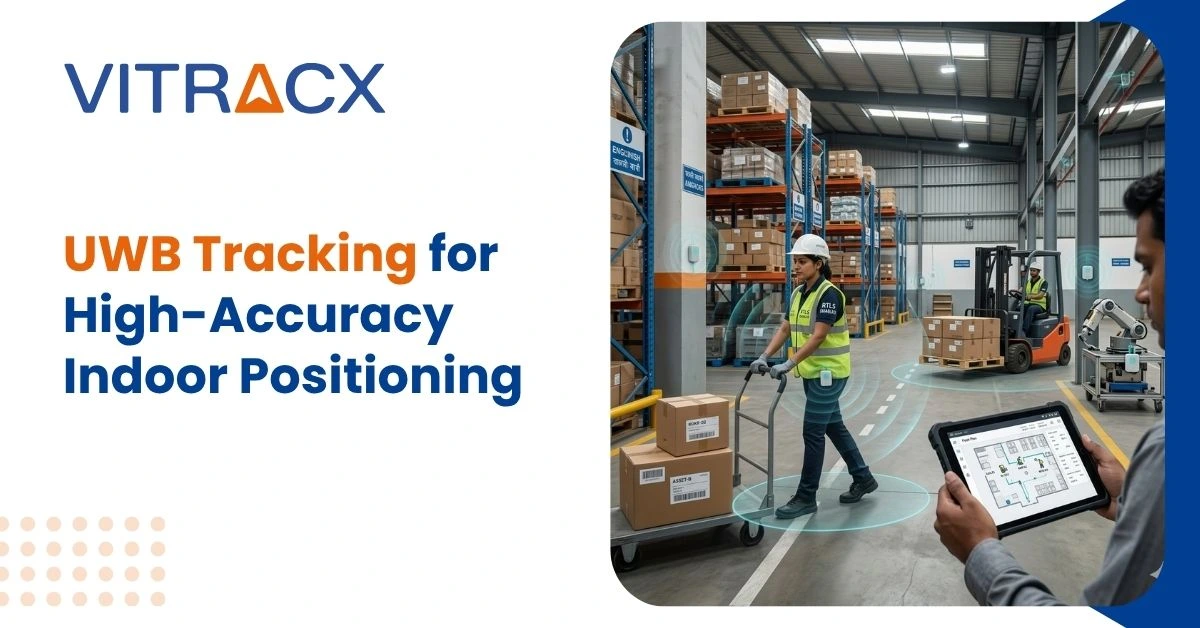
Modern industrial environments demand more than basic location visibility. Manufacturing plants, warehouses, assembly lines, and high-security operational zones require precise, real-time positioning to improve productivity, strengthen safety, and support faster decisions. This is where UWB Tracking plays a transformative role.

Ultra-Wideband technology delivers centimetre-level indoor positioning, making it one of the most accurate real-time locating technologies available today. Unlike conventional tracking systems that may struggle with interference or positioning inconsistencies, UWB Tracking is designed for environments where precision is critical.

What is UWB Tracking?

UWB Tracking refers to indoor positioning using Ultra-Wideband radio technology to determine the real-time location of assets, equipment, and personnel with extremely high accuracy.

UWB operates by transmitting short radio pulses across a wide frequency spectrum. Using techniques such as Time of Flight (ToF) and Time Difference of Arrival (TDoA), the system calculates precise location data between tags and anchors installed within a facility.

This technology is particularly valuable in industrial settings because it delivers:

  • 10–30 cm positioning accuracy
  • Real-time location updates
  • Low latency tracking
  • Stable performance in complex indoor environments
  • Reduced interference and multipath errors

For organisations pursuing Industry 4.0 initiatives, UWB Tracking provides the location intelligence needed to automate workflows and improve operational visibility.

Why High-Accuracy Indoor Positioning Matters?

Indoor operations often involve moving assets, production materials, mobile equipment, and personnel across dynamic environments. Manual searching and limited visibility can create delays, safety risks, and inefficient resource use.

High-accuracy indoor positioning addresses these challenges by providing live visibility across operations.

Operational Challenge How UWB Tracking Helps
Asset search delays Provides instant real-time location visibility
Production bottlenecks Tracks WIP and material movement
Safety concerns Monitors personnel in sensitive zones
Equipment misplacement Enables precise equipment location
Workflow inefficiencies Supports automated and data-driven operations

Because UWB Tracking delivers dependable positioning, organisations can move from reactive operations to proactive decision-making.

How UWB Tracking Works?

A typical UWB Tracking deployment combines tags, anchors, positioning algorithms, and software intelligence.

UWB tags attached to assets, tools, vehicles, or personnel continuously send radio pulses to anchors positioned across the facility. The system measures signal travel time using ToF or TDoA calculations to determine exact locations.

The positioning engine processes this data and displays it through dashboards, maps, alerts, and analytics platforms.

At Vitracx, this location intelligence can integrate with existing:

  • ERP systems
  • MES platforms
  • WMS solutions
  • Workflow automation systems

This integration creates connected operations where location data supports automation, visibility, and faster decision-making.

Looking to improve indoor visibility and operational precision? Contact us for UWB Tracking solutions can help your organisation.

Key Benefits of UWB Tracking

One of the biggest strengths of UWB Tracking is its ability to perform reliably in demanding industrial environments.

Ultra-High Accuracy

UWB delivers 10–30 cm accuracy, making it suitable for safety-critical and precision-dependent operations. This level of positioning supports confident operational decisions and precise workflow execution.

Reliable Performance in Metal-Rich Environments

Many industrial facilities contain machinery, steel structures, and reflective surfaces that interfere with conventional technologies. UWB’s wide bandwidth helps reduce interference and multipath effects, allowing stable performance even in high-metal environments.

Real-Time Operational Visibility

Low-latency location updates help organisations maintain live visibility of moving assets and personnel. This supports faster responses and improved operational control.

Industry 4.0 and Automation Support

As an RTLS technology, UWB Tracking strengthens digital transformation by enabling:

  • Automated alerts
  • Geofencing
  • Workflow automation
  • Utilization analytics
  • Location-based decision-making

Industrial Applications of UWB Tracking

Because of its precision, UWB Tracking supports multiple operational use cases across industries. In manufacturing, UWB helps monitor chassis movement and assembly-line progression, reducing bottlenecks and improving production flow.

For warehouses and logistics facilities, it enables live visibility of forklifts, pallet movers, and internal transport vehicles, improving routing and reducing idle time. Equipment and trolley tracking becomes significantly easier with precise indoor visibility, helping teams locate tools and workshop assets without delays.

Personnel monitoring is another important application. Sensitive and restricted operational areas benefit from real-time location visibility, helping organisations strengthen safety and emergency response readiness. Finished goods and WIP tracking also benefit from UWB positioning, allowing organisations to monitor material movement and improve process efficiency.

UWB Tracking and the Future of Smart Operations

Industrial digital transformation depends on connected intelligence. Location data is no longer a secondary operational tool; it is becoming a foundation for smarter operations.

UWB Tracking supports this transition by providing accurate, actionable visibility that enables organisations to optimise workflows, improve asset utilisation, and strengthen operational resilience.

When combined with intelligent software and integrated automation platforms, UWB becomes more than a tracking technology. It becomes an operational intelligence system that supports long-term efficiency and connected decision-making.

Frequently Asked Questions

UWB Tracking is used for real-time indoor positioning of assets, tools, vehicles, and personnel with centimetre-level accuracy.

UWB Tracking can achieve positioning accuracy between 10–30 cm depending on deployment conditions and system configuration.

Yes. UWB performs reliably in manufacturing environments, including metal-rich facilities and complex production floors.

While RFID and BLE offer strong visibility capabilities, UWB Tracking provides significantly higher indoor positioning accuracy and lower latency.

Yes. Modern UWB RTLS platforms can integrate with ERP, MES, and WMS systems to support connected workflows and automation.

Conclusion

UWB Tracking is redefining indoor positioning by delivering ultra-high accuracy, reliable real-time visibility, and stronger operational intelligence. From manufacturing floors to logistics environments, organisations can reduce delays, improve safety, and build smarter workflows using centimetre-level positioning.

As Industry 4.0 adoption continues to grow, UWB Tracking will remain a critical technology for organisations seeking connected, efficient, and data-driven operations. With integrated hardware, software, and automation capabilities, we helps businesses transform indoor visibility into measurable operational value.

Back To Top