In today’s competitive industrial landscape, maintaining complete visibility of valuable assets is essential for achieving operational efficiency, reducing losses, and supporting digital transformation initiatives. Many organizations still rely on manual asset tracking methods, spreadsheets, or barcode systems, which often lead to misplaced equipment, inaccurate inventory records, and time-consuming searches. RFID Asset Tracking provides a smarter approach by enabling automatic identification and real-time monitoring of assets throughout their lifecycle. Using RFID tags and readers, organizations can accurately track equipment, tools, materials, and inventory without manual intervention. This automated approach improves traceability, minimizes operational errors, and enhances decision-making across manufacturing facilities, warehouses, logistics centers, and healthcare environments.
As businesses continue to embrace Industry 4.0 and connected operations, RFID Asset Tracking has become an essential technology for improving operational control, increasing asset utilization, and building more efficient industrial workflows.
Why Asset Visibility Matters in Industrial Operations?
Industrial facilities manage thousands of valuable assets every day, including machinery, production tools, mobile equipment, pallets, raw materials, and finished goods. Without accurate visibility, organizations often struggle with misplaced assets, delayed production, inventory inaccuracies, and unnecessary operational costs.
Limited asset visibility can also impact equipment availability, maintenance planning, and overall productivity. Employees may spend significant time searching for critical tools or equipment instead of focusing on value-added activities.
Implementing RFID Asset Tracking helps organizations eliminate these inefficiencies by providing accurate, automated visibility across every stage of asset movement, enabling faster decisions and better operational control.
What is RFID Asset Tracking?
RFID Asset Tracking is an automated identification and tracking solution that uses Radio Frequency Identification (RFID) technology to monitor the movement and status of physical assets without requiring direct line-of-sight scanning.
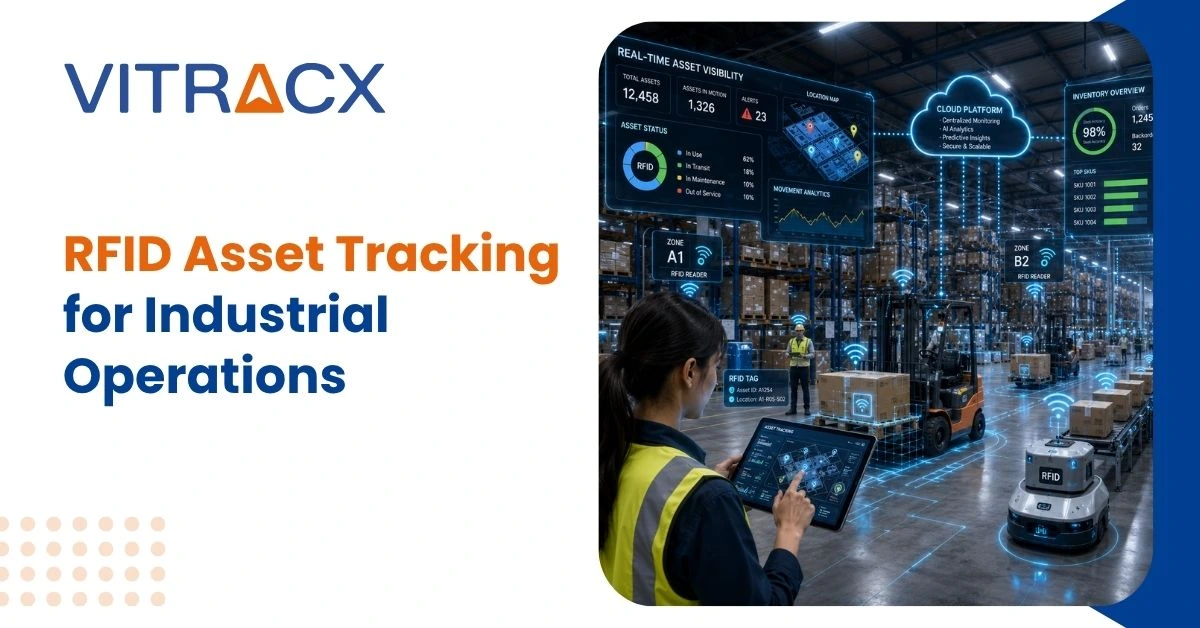
Each asset is equipped with an RFID tag containing a unique identification number. RFID readers installed at strategic locations automatically detect tagged assets as they move throughout a facility. The captured information is transmitted to centralized software, where organizations can monitor asset locations, movement history, and operational status in real time.
Unlike conventional barcode systems that require manual scanning, RFID technology enables hands-free data capture, reducing manual effort while improving accuracy and workflow efficiency.
How RFID Asset Tracking Works?
An RFID Asset Tracking system consists of four primary components:
- RFID Tags
- RFID Readers
- Communication Infrastructure
- Asset Management Software
RFID tags attached to assets continuously interact with nearby RFID readers whenever they enter designated read zones. The collected data is securely transmitted to the software platform, where asset information is automatically updated and made available through dashboards, reports, and alerts.
The system enables organizations to:
- Automatically identify assets
- Record asset movement
- Monitor asset availability
- Improve inventory accuracy
- Generate audit trails
- Support operational reporting
By eliminating manual data collection, RFID Asset Tracking creates reliable digital records that improve operational visibility and support informed decision-making.
Benefits of RFID Asset Tracking for Industrial Operations
Organizations across multiple industries are adopting RFID Asset Tracking because it delivers measurable improvements in operational performance.
Improved Asset Visibility
Real-time identification allows organizations to quickly locate equipment, tools, inventory, and production assets, reducing search time and improving resource availability.
Reduced Manual Errors
Automatic data capture minimizes human intervention, reducing data entry mistakes, missed scans, and inventory discrepancies that commonly occur with manual tracking methods.
Faster Inventory Management
RFID enables multiple tagged assets to be identified simultaneously, significantly reducing inventory counting time while improving inventory accuracy.
Better Asset Utilization
Organizations gain valuable insights into asset movement and usage patterns, helping optimize equipment utilization and reduce unnecessary asset purchases.
Enhanced Traceability
Every asset movement is automatically recorded, providing complete traceability that supports compliance, quality control, and operational audits.
| Operational Challenge |
How RFID Asset Tracking Helps |
| Manual asset searches |
Provides automatic asset identification and faster location visibility |
| Inventory inaccuracies |
Improves inventory accuracy through automated data capture |
| Equipment misplacement |
Maintains continuous asset movement records |
| Time-consuming audits |
Generates digital asset history and traceability |
| Inefficient workflows |
Automates tracking processes and reduces manual intervention |
Applications of RFID Asset Tracking Across Industries
The flexibility of RFID technology makes it suitable for a wide range of industrial applications.
In manufacturing facilities, RFID Asset Tracking helps monitor production tools, raw materials, workstations, and finished goods throughout the production process. This improves production visibility while reducing delays caused by misplaced assets.
Warehouses use RFID to automate inventory management, monitor pallet movement, and improve order fulfillment accuracy.
Logistics providers benefit from improved shipment visibility, faster loading and unloading operations, and enhanced asset traceability across distribution networks.
Healthcare organizations use RFID Asset Tracking to monitor medical equipment, wheelchairs, diagnostic devices, and other critical assets, ensuring they remain available when needed.
Commercial facilities also use RFID to improve equipment management, document tracking, and operational efficiency.