
Manufacturing plants and warehouses rely on equipment such as forklifts, tools, trolleys, and other mobile…
- 10 minute read
- Product Guide
- Kunj Patel
Modern industrial and commercial environments need continuous visibility into physical conditions, equipment activity, and operational events. IoT Sensors provide this visibility by detecting changes in the surrounding environment and collecting real-time data that can be used for monitoring, alerts, automation, and decision-making.
From temperature and humidity to occupancy, door activity, motion, distance, and equipment conditions, IoT Sensors support a wide range of connected applications. When integrated with platforms such as RTLS, RFID, ERP, WMS, BMS, and cloud systems, sensor data can be transformed into actionable operational insights.
Vitracx provides Bluetooth and GPS + LoRa based sensing solutions designed for indoor and outdoor monitoring across manufacturing plants, warehouses, healthcare facilities, commercial spaces, and other connected environments.
What Are IoT Sensors?
Connected sensing devices, known as IoT Sensors, detect physical conditions or activities and collect data for monitoring and analysis. Depending on their purpose, these devices can measure environmental conditions, detect movement or presence, identify changes in access status, monitor distance, or record equipment and asset conditions.
The collected information can be transmitted to a connected platform where organizations can monitor conditions in real time, generate alerts, and use the information to improve operational visibility.
Unlike standalone sensors that only provide local readings, connected IoT Sensors can become part of a broader monitoring ecosystem. This allows sensor data to support automated workflows, centralized monitoring, and smarter operational decisions.
How Do IoT Sensors Work?
IoT Sensors generally work through a simple connected monitoring process:
- Sensing – The sensor detects a physical condition, activity, or environmental change.
- Data Collection – The device records the measured information.
- Data Transmission – Sensor data is communicated through an appropriate wireless or connected network.
- Platform Processing – The information is received and processed by the monitoring platform.
- Monitoring and Alerts – Users can view data, identify changes, and receive alerts when defined conditions or thresholds occur.
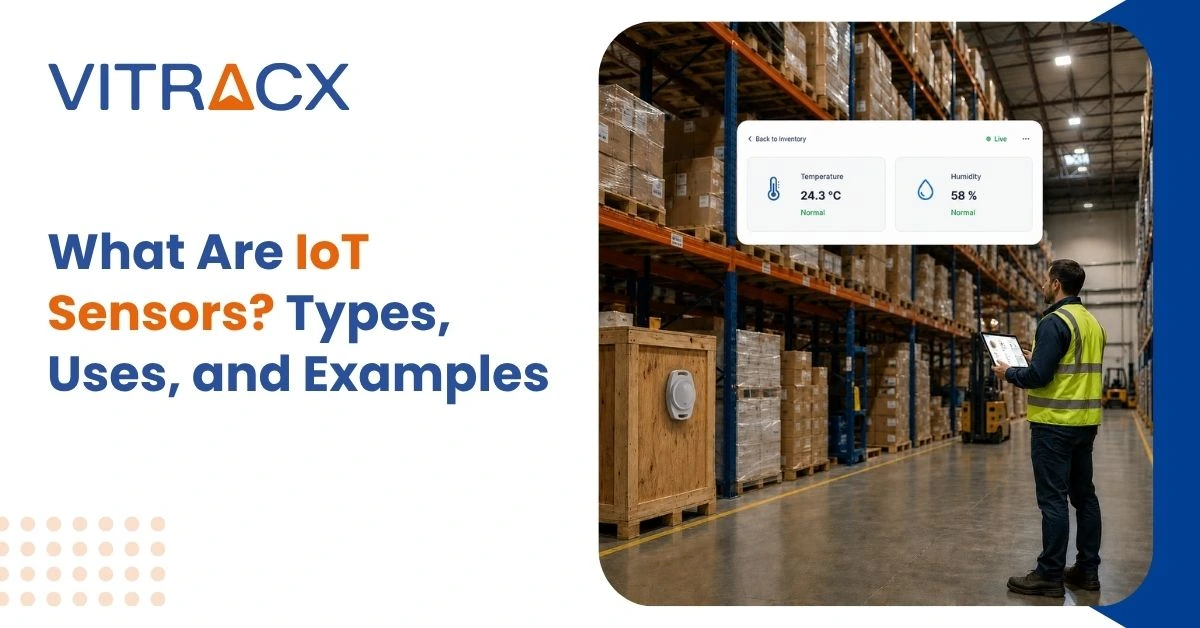
For example, a temperature sensor can continuously monitor an environment and provide temperature data to a connected platform. If the monitored condition changes beyond a defined requirement, the system can generate an alert for faster response.
Types of IoT Sensors
Different monitoring requirements call for different types of sensing technologies. Based on the Vitracx IoT monitoring ecosystem, several sensor types are used for environmental monitoring, presence detection, access monitoring, distance measurement, and condition monitoring.
Temperature and Humidity Sensors
Temperature and humidity sensors monitor environmental conditions continuously. They are useful in facilities where maintaining suitable environmental conditions is important for operations, storage, or equipment.
Vitracx Bluetooth sensor solutions include T&H sensors designed for indoor monitoring. The H4 and H4 Pro sensors provide temperature and humidity monitoring for environments such as warehouses, manufacturing plants, hospitals, and commercial spaces.
PIR Presence Sensors
PIR presence sensors detect human presence within a defined area. They can support occupancy monitoring and help organizations understand how spaces are being used.
The Vitracx S01P PIR Presence Sensor is designed for human presence detection and can support applications such as room occupancy monitoring and connected facility management.
Time-of-Flight Range Sensors
Time-of-Flight sensors measure distance by using time-based distance measurement technology. They can help detect whether a space, shelf, or area is occupied or available.
The Vitracx S02R TOF Range Sensor supports distance measurement up to 3 metres and can be used for applications such as space and shelf availability monitoring.
Door Sensors
Door sensors detect whether doors or access points are opened or closed. They can be used to monitor access activity and generate alerts when unexpected activity occurs.
Vitracx S03D Door Sensors support reliable door open/close detection and include tamper alarm functionality. Such sensors can be applied to restricted areas, data centers, server rooms, and other locations where access monitoring is important.
Condition Sensors
Condition sensors combine multiple sensing capabilities into a single device. Depending on the sensor configuration, these devices can monitor conditions such as temperature, humidity, door status, and pressure.
The Vitracx L02S Condition Sensor provides multi-condition monitoring and is designed for applications requiring combined environmental and operational monitoring.
Temperature Loggers
Temperature loggers continuously record temperature information over time. They are useful where organizations need historical temperature records in addition to real-time monitoring.
The Vitracx S05T Temperature Logger supports more than 60,000 temperature data logs and is designed as a lightweight, cost-effective monitoring solution.
Common IoT Sensors Examples
Examples of IoT Sensors can be found across manufacturing, warehousing, healthcare, commercial facilities, and other connected environments. Their applications depend on what organizations need to monitor and how the collected data is used.
Common examples include:
- Temperature monitoring sensors
- Humidity monitoring sensors
- PIR presence sensors
- Time-of-Flight range sensors
- Door status sensors
- Condition monitoring sensors
- Temperature data loggers
- GPS + LoRa sensors
These devices can support both standalone monitoring requirements and larger connected systems.
Examples of Sensors in IoT Applications
The Examples of Sensors in IoT become clearer when looking at real operational applications.
Unauthorized Access Monitoring
Door sensors can detect unexpected door or window openings and generate alerts for security teams. This helps organizations respond quickly to unauthorized access events.
Room Occupancy Monitoring
Presence sensors can identify human occupancy in meeting rooms, workspaces, and other areas. This information can help organizations understand space utilization and improve facility planning.
Shelf and Storage Availability
Range sensors can detect whether storage spaces or shelves are occupied. This can help warehouses understand available storage capacity and reduce unnecessary searching.
Healthcare Access Monitoring
Connected sensors can monitor access to areas such as medicine cabinets, incubators, and restricted rooms. Real-time access information can support safety and compliance requirements.
Data Center Access Monitoring
Door sensors can monitor access to server rooms and critical equipment areas. Organizations can record door activity and identify unexpected access events.
Truck and Container Door Monitoring
Sensors can detect unauthorized opening of truck and container doors. This provides an additional layer of visibility during transportation and helps identify potential security events.
Smart Parking Monitoring
Connected sensing technology can identify available parking spaces in real time. This can help guide vehicles and reduce unnecessary movement within facilities.
Emergency Assistance
Emergency alert devices can allow users to send an immediate alert when assistance is required. Such applications can support monitoring in high-risk environments and care facilities.
Different Types of IoT Sensors for Industrial Monitoring
The Different Types of IoT Sensors used in industrial environments can be selected according to the condition or activity that needs to be monitored.
| Sensor Type | What It Monitors | Example Application |
| Temperature Sensor | Temperature | Facility and equipment monitoring |
| Humidity Sensor | Humidity | Environmental monitoring |
| PIR Sensor | Human presence | Occupancy monitoring |
| TOF Sensor | Distance | Shelf and space availability |
| Door Sensor | Door activity | Access monitoring |
| Condition Sensor | Multiple conditions | Industrial condition monitoring |
| Temperature Logger | Temperature history | Long-term temperature recording |
| GPS + LoRa Sensor | Outdoor location | Asset and vehicle monitoring |
This range allows organizations to combine different sensing technologies according to their operational requirements.
IoT Devices Examples for Connected Operations
IoT Devices Examples extend beyond individual sensors. A complete monitoring ecosystem can include sensing devices, communication infrastructure, software platforms, gateways, and connected enterprise systems.
Within the Vitracx ecosystem, IoT sensors can integrate with:
- RTLS platforms
- RFID systems
- ERP platforms
- WMS platforms
- BMS platforms
- Cloud platforms
- Industrial automation systems
This integration allows sensor information to become part of a centralized operational environment instead of remaining isolated at the device level.
Looking to improve real-time monitoring across your facility? Contact Us today for reliable IoT Sensors and connected monitoring solutions tailored to your operational needs.
Benefits of IoT Sensors
Organizations use IoT Sensors to improve visibility and respond more effectively to changing operational conditions.
Key benefits include:
- Real-time monitoring
- Automated alerts
- Continuous environmental visibility
- Improved operational awareness
- Faster response to abnormal conditions
- Reduced manual monitoring
- Better facility utilization
- Support for connected workflows
- Integration with enterprise systems
- Scalable Industry 4.0 deployment
These benefits make IoT sensing useful across both small monitoring applications and larger connected industrial environments.
IoT Sensors for Indoor and Outdoor Monitoring
IoT monitoring requirements vary depending on the environment. Indoor facilities may require temperature, humidity, occupancy, door, and proximity monitoring, while outdoor operations may require connected GPS + LoRa sensing for broader location visibility.
Vitracx supports both indoor and outdoor monitoring through its Bluetooth and GPS + LoRa sensor technologies. This enables organizations to build connected monitoring environments across warehouses, manufacturing plants, commercial facilities, healthcare environments, and outdoor operational areas.
IoT Sensors and Industry 4.0
Industry 4.0 depends on connected systems that can collect operational information and make it available for analysis and decision-making. IoT Sensors provide the sensing layer required to capture this information from physical environments.
When sensor data is connected with RTLS, RFID, cloud platforms, ERP, WMS, BMS, and automation systems, organizations can create a unified visibility ecosystem. This supports real-time monitoring, automated alerts, digital transformation, and more informed operational decisions.
For manufacturers, warehouses, healthcare facilities, and commercial environments, IoT sensing can therefore become an important part of building connected and scalable operations.
Choosing the Right IoT Sensors
Selecting the appropriate sensor depends on the condition or activity that needs to be monitored. Organizations should consider:
- What needs to be measured or detected
- Required monitoring range
- Indoor or outdoor deployment
- Environmental conditions
- Data logging requirements
- Battery and maintenance requirements
- Alert and monitoring needs
- Required system integrations
- Future scalability
Choosing sensors according to the actual monitoring requirement helps organizations create an efficient and reliable IoT monitoring environment.
Frequently Asked Questions
IoT Sensors are connected sensing devices that detect physical conditions, activities, or environmental changes and collect data for monitoring, analysis, alerts, and connected operations.
Based on the Vitracx IoT monitoring ecosystem, sensor types include temperature and humidity sensors, PIR presence sensors, TOF range sensors, door sensors, condition sensors, and temperature loggers.
IoT Sensors are used in manufacturing plants, warehouses, hospitals, commercial spaces, data centers, storage areas, and other indoor and outdoor environments requiring continuous monitoring.
Examples include temperature sensors, humidity sensors, PIR presence sensors, TOF range sensors, door sensors, condition sensors, temperature loggers, and GPS + LoRa sensors.
Yes. Vitracx IoT sensors can integrate with RTLS, RFID, ERP, WMS, BMS, cloud platforms, and automation systems to create a connected monitoring ecosystem.
Conclusion
Different sensor technologies, including IoT Sensors, provide the foundation for collecting real-time information from physical environments. From temperature and humidity to presence, distance, door activity, and equipment conditions, these technologies support different monitoring requirements.
When connected with RTLS, RFID, ERP, WMS, BMS, cloud, and automation platforms, these sensors can transform individual measurements into useful operational insights. With applications ranging from manufacturing and warehousing to healthcare and commercial facilities, IoT Sensors support continuous monitoring, automated alerts, and connected Industry 4.0 operations.
Different Types of IoT SensorsExamples of Sensors in IoTIoT Devices ExamplesIoT Sensors ExamplesTypes of IoT Sensors

Kunj Patel is Co-Founder & CGO at Vitracx, where he designs and scopes RTLS solutions for manufacturing, warehouse, and healthcare clients — turning shop-floor tracking challenges into working systems. He writes about solutioning for Industry 4.0 and real-time visibility.
Related Posts
Material handling equipment (MHE) such as forklifts, pallet movers, tuggers, and other internal vehicles constantly…

Material movement is a critical part of factory operations. Raw materials, components, WIP, tools, and…
