Skip to content
UWB Tracking for Worker Safety Monitoring

Ensuring worker safety is one of the highest priorities in industrial environments where employees operate alongside heavy machinery, automated production lines, overhead cranes, forklifts, and other moving equipment. While conventional safety measures such as PPE, warning signs, and manual supervision remain essential, they often provide limited visibility into a worker’s real-time location, especially within large and complex facilities.

This is where UWB Tracking transforms workplace safety. By delivering centimetre-level indoor positioning accuracy, Ultra-Wideband technology enables organizations to continuously monitor worker locations, detect entry into hazardous areas, and generate instant safety alerts when potential risks arise. Unlike conventional indoor positioning technologies, UWB performs reliably even in metal-rich manufacturing environments where precision is critical. As industries continue to embrace Industry 4.0, UWB Tracking is helping organizations create safer, smarter, and more connected workplaces.

Why Worker Safety Requires Real-Time Location Visibility?

Industrial facilities are dynamic environments where employees, forklifts, production equipment, and automated systems operate simultaneously. In these settings, knowing a worker’s exact location can be critical for preventing accidents and responding quickly during emergencies.

Traditional safety procedures often rely on manual supervision, CCTV systems, or access control methods that cannot provide continuous indoor location visibility. This creates challenges such as:

  • Workers entering restricted operational zones unnoticed
  • Limited visibility during emergency evacuations
  • Delayed response to workplace incidents
  • Increased risk around moving machinery and forklifts
  • Difficulty locating personnel inside large industrial facilities

By implementing UWB Tracking, organizations gain precise, real-time worker visibility that supports proactive safety management instead of reactive incident response.

What is UWB Tracking?

Designed for ultra-precise indoor positioning, UWB Tracking uses Ultra-Wideband radio technology to determine the exact location of people and assets within industrial environments.

Workers wear compact UWB-enabled tags attached to helmets, ID cards, or safety vests. These tags communicate with strategically installed UWB anchors throughout the facility. Using positioning methods such as Time of Flight (ToF) and Time Difference of Arrival (TDoA), the system calculates the worker’s location with an accuracy of approximately 10–30 cm.

Unlike conventional indoor positioning technologies, UWB maintains highly reliable performance even in metal-heavy manufacturing facilities, making it suitable for safety-critical industrial applications where precise location data is essential.

How UWB Tracking Improves Worker Safety?

Maintaining continuous awareness of worker locations enables organizations to identify potential safety risks before incidents occur. UWB Tracking provides this visibility by monitoring personnel movement in real time and generating automated alerts whenever predefined safety conditions are triggered.

Instead of relying solely on manual supervision, organizations receive continuous location updates that improve operational awareness across production areas, warehouses, assembly lines, and maintenance zones.

This enables safety teams to:

  • Identify workers approaching hazardous operational areas.
  • Monitor personnel movement across restricted zones.
  • Improve emergency response by locating workers instantly.
  • Reduce manual safety inspections.
  • Enhance compliance with workplace safety procedures.
  • Strengthen overall operational visibility.

Continuous monitoring helps create a safer working environment while reducing the likelihood of workplace accidents.

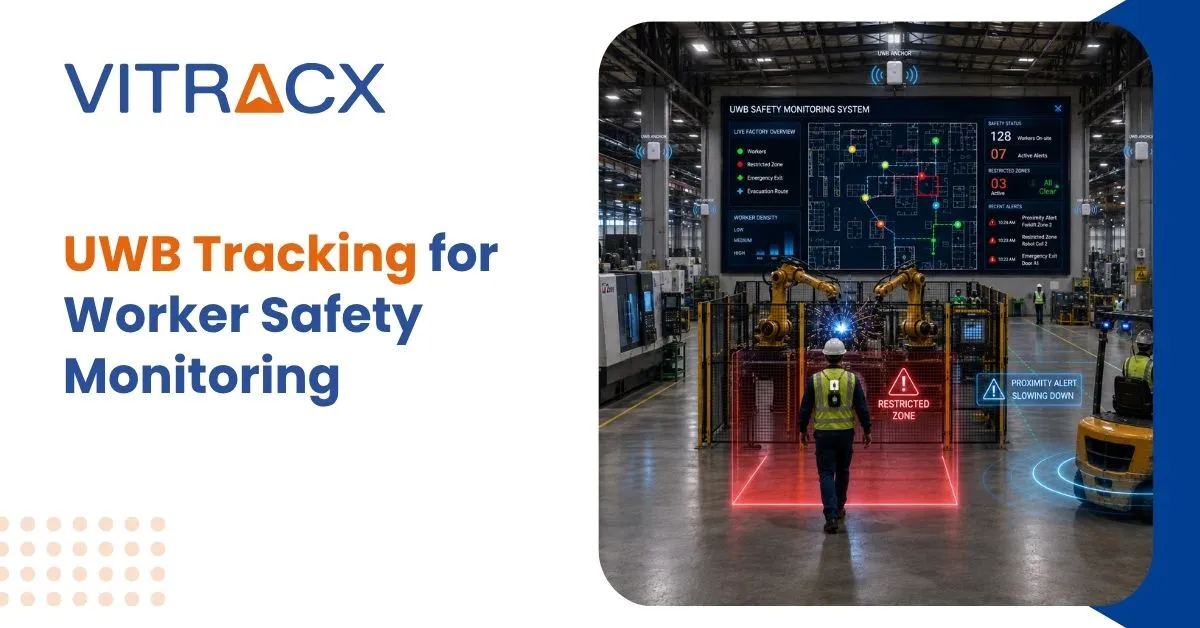
Hazardous Zone Monitoring with UWB Tracking

Many industrial facilities contain areas where worker access must be carefully controlled due to moving machinery, robotic systems, high-voltage equipment, or heavy lifting operations.

With UWB Tracking, organizations can create virtual geofences around these high-risk locations. Whenever a worker enters or approaches a restricted zone, the system immediately generates automated notifications for supervisors and safety personnel.

Hazardous zone monitoring supports applications such as:

  • Robotic welding cells
  • CNC machining areas
  • Overhead crane operating zones
  • High-voltage electrical rooms
  • Chemical storage areas
  • Heavy manufacturing equipment
  • Maintenance work zones

By detecting unsafe movement before an incident occurs, UWB Tracking strengthens workplace safety without interrupting daily operations.

Looking to improve worker safety with centimetre-level indoor positioning? Contact Us today to explore advanced UWB Tracking solutions for your industrial operations.

Collision Prevention Around Moving Equipment

Forklifts, pallet movers, tow tractors, and other material handling equipment constantly move throughout industrial facilities. Limited visibility between operators and nearby workers can significantly increase the risk of workplace accidents. UWB Tracking improves situational awareness by monitoring the position of both workers and moving equipment simultaneously. When workers enter predefined proximity zones around operating vehicles, the system can trigger immediate alerts that allow operators and supervisors to take preventive action.

This helps organizations:

  • Improve forklift safety
  • Reduce collision risks
  • Protect workers in shared operational spaces
  • Improve material handling safety
  • Support safer production environments

Accurate positioning enables safer interaction between personnel and industrial vehicles while minimizing operational disruption.

Faster Emergency Response Through Real-Time Location

During emergencies, quickly locating personnel can significantly improve response times and evacuation efficiency. Manual attendance checks and physical searches become increasingly difficult inside large manufacturing plants or complex industrial facilities.

Using UWB Tracking, safety teams can instantly identify the real-time location of workers throughout the facility. This enables faster emergency coordination while improving accountability during evacuation procedures.

Real-time worker visibility supports:

  • Emergency evacuation planning
  • Personnel accountability
  • Faster rescue coordination
  • Worker location verification
  • Incident investigation
  • Improved emergency preparedness

Access to accurate location information allows emergency teams to respond more effectively while improving workplace resilience.

Applications of UWB Tracking for Worker Safety

Industrial organizations implement UWB Tracking across multiple safety-critical operations where accurate indoor positioning improves both worker protection and operational control.

Worker Safety Application How UWB Tracking Helps
Restricted Zone Monitoring Detects unauthorized worker entry into hazardous areas
Worker Location Monitoring Provides continuous real-time personnel visibility
Forklift Safety Reduces collision risks between workers and vehicles
Emergency Evacuation Helps locate workers quickly during emergencies
Assembly Line Safety Monitors worker movement around automated production equipment
Maintenance Activities Improves personnel visibility during maintenance operations
Heavy Equipment Operations Enhances worker safety around cranes and industrial machinery

Advantages of UWB Tracking for Worker Safety

Industrial facilities choose UWB Tracking because it delivers the positioning accuracy required for safety-critical environments where reliable worker visibility is essential.

  • Centimetre-level indoor positioning accuracy
  • Continuous real-time worker monitoring
  • Reliable performance in metal-rich industrial environments
  • Automated geofencing and restricted zone alerts
  • Faster emergency response and personnel location
  • Low-latency location updates
  • Scalable deployment across manufacturing facilities
  • Integration with RTLS and Industry 4.0 platforms

UWB Tracking Supports Safer Industry 4.0 Operations

As industrial facilities become increasingly connected, worker safety is evolving from manual supervision to intelligent, data-driven monitoring. UWB Tracking provides the precise location intelligence needed to improve workplace safety while supporting connected manufacturing environments.

Integrated with RTLS platforms, industrial automation systems, and enterprise applications, UWB Tracking enables organizations to monitor personnel continuously, automate safety workflows, and strengthen operational decision-making. This connected approach not only helps reduce workplace risks but also supports long-term digital transformation by creating safer, smarter, and more efficient industrial operations.

Frequently Asked Questions

UWB Tracking uses Ultra-Wideband technology to monitor the real-time location of workers with centimetre-level accuracy. It helps organizations improve workplace safety by providing continuous visibility and instant alerts in hazardous industrial environments.

By continuously monitoring worker locations, UWB Tracking helps detect entry into restricted zones, supports faster emergency response, reduces collision risks, and improves overall workplace safety.

UWB Tracking is widely used in manufacturing plants, automotive facilities, warehouses, heavy engineering units, assembly lines, and other industrial environments where precise worker positioning is critical.

UWB Tracking provides 10–30 cm positioning accuracy with reliable performance in metal-rich environments, making it ideal for applications where precise worker location is essential for safety.

Yes. UWB Tracking integrates with RTLS platforms, ERP, MES, WMS, and other Industry 4.0 systems to improve operational visibility, automate safety workflows, and support connected industrial environments.

Conclusion

Protecting workers in modern industrial environments requires more than traditional safety measures. As facilities become larger, more automated, and increasingly complex, organizations need accurate real-time visibility to identify risks before they become incidents.

UWB Tracking delivers centimetre-level indoor positioning that enables organizations to monitor worker movement, strengthen restricted zone protection, improve emergency response, and reduce workplace risks. By integrating with connected industrial platforms, UWB Tracking helps build safer, smarter, and more efficient workplaces while supporting Industry 4.0 and long-term operational excellence.

Back To Top