Efficient movement of forklifts, tow trucks, pallet movers, and other industrial vehicles is essential for maintaining productivity across manufacturing plants, warehouses, and logistics facilities. However, limited visibility into vehicle locations often leads to unnecessary delays, longer material movement cycles, increased idle time, and inefficient resource utilization. These challenges not only impact operational efficiency but also affect production schedules and overall workflow performance.
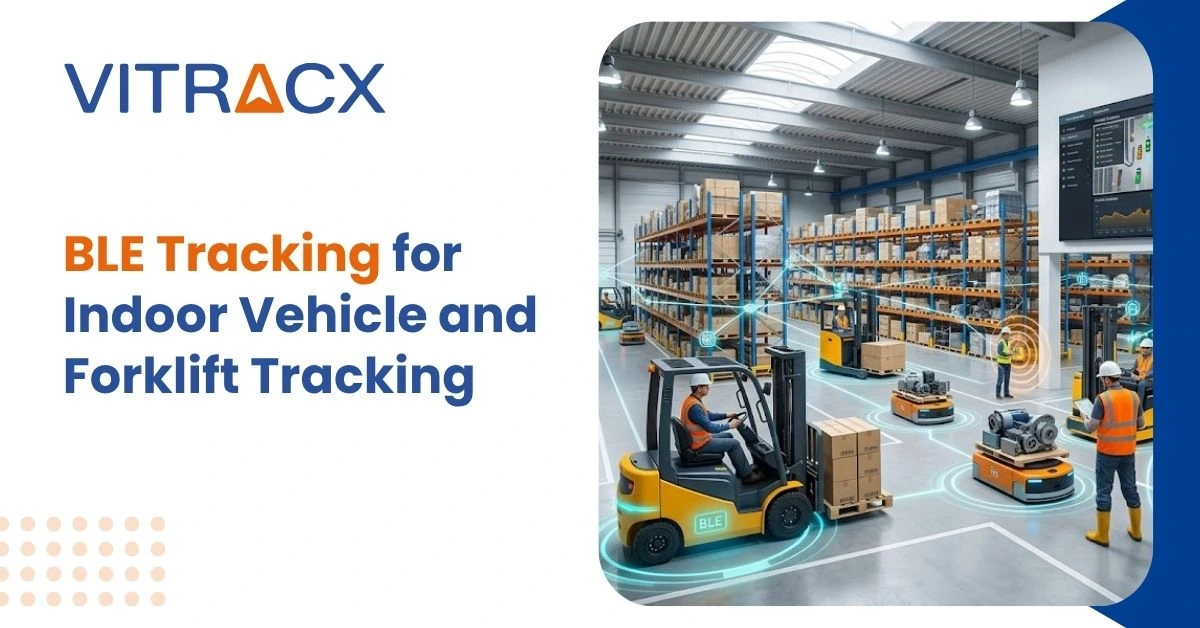
By implementing BLE Tracking, organizations can monitor the real-time location of indoor vehicles and forklifts, enabling faster dispatch, improved fleet utilization, and better operational control. Using Bluetooth Low Energy technology and an intelligent RTLS platform, businesses gain continuous visibility into vehicle movement, helping optimize material handling processes while supporting safer and more connected industrial operations.
Why Indoor Vehicle and Forklift Visibility Matters?
Industrial vehicles play a critical role in transporting raw materials, work-in-progress (WIP), finished goods, and equipment between different operational areas. When their locations are unknown, operators often spend valuable time searching for available vehicles, resulting in delayed production activities and reduced operational efficiency.
Limited visibility also makes it difficult to monitor vehicle movement, identify idle equipment, optimize travel routes, and balance fleet utilization across departments. Without accurate location data, organizations may struggle to improve material flow and maximize the productivity of their existing vehicle fleet.
Modern industrial facilities are adopting BLE Tracking to gain continuous visibility into indoor vehicle operations, enabling better coordination, faster response times, and improved operational performance.
What is BLE Tracking?
Powered by Bluetooth Low Energy technology, BLE Tracking is an indoor positioning solution that monitors the real-time location of vehicles, forklifts, mobile equipment, assets, and personnel across industrial environments.
BLE tags installed on forklifts and industrial vehicles periodically transmit Bluetooth signals that are captured by strategically placed gateways or locators. The RTLS platform processes this information to provide live location updates, movement history, utilization reports, and operational analytics through a centralized dashboard.
Depending on operational requirements, organizations can deploy:
- BLE AoA (Angle of Arrival) for higher positioning accuracy.
- BLE RSSI (Received Signal Strength Indicator) for reliable zone-based tracking.
This flexibility allows businesses to choose the most suitable positioning method based on their operational workflows, facility layout, and tracking objectives.
How BLE Tracking Improves Indoor Vehicle and Forklift Tracking?
Managing indoor vehicles requires continuous visibility into their location, movement, and utilization. BLE Tracking enables organizations to monitor forklifts and industrial vehicles in real time, helping operators quickly identify available equipment and reducing delays caused by manual searching.
Real-time vehicle visibility also helps supervisors monitor movement across production lines, warehouses, storage areas, and loading zones. By analyzing travel patterns and equipment utilization, organizations can optimize routes, reduce unnecessary movement, and improve overall fleet efficiency.
In addition, BLE Tracking supports better coordination between material handling activities and production operations, ensuring that vehicles are available where and when they are needed to maintain smooth workflow execution.
| Operational Challenge |
How BLE Tracking Helps |
| Difficulty locating forklifts |
Provides real-time vehicle visibility |
| High vehicle idle time |
Monitors utilization and movement patterns |
| Delayed material transportation |
Enables faster vehicle dispatch |
| Inefficient travel routes |
Supports route optimization using movement data |
| Limited operational visibility |
Delivers live dashboards and fleet analytics |
Advantages of BLE Tracking for Indoor Vehicle and Forklift Tracking
Organizations can improve vehicle visibility and operational efficiency by implementing BLE Tracking across their indoor transportation workflows.
- Real-time visibility of forklifts and industrial vehicles
- Faster vehicle identification and dispatch
- Improved fleet utilization and operational efficiency
- Better coordination of material handling activities
- Flexible deployment using BLE AoA or BLE RSSI
- Easy integration with RTLS, ERP, and MES platforms
- Scalable infrastructure for expanding industrial facilities