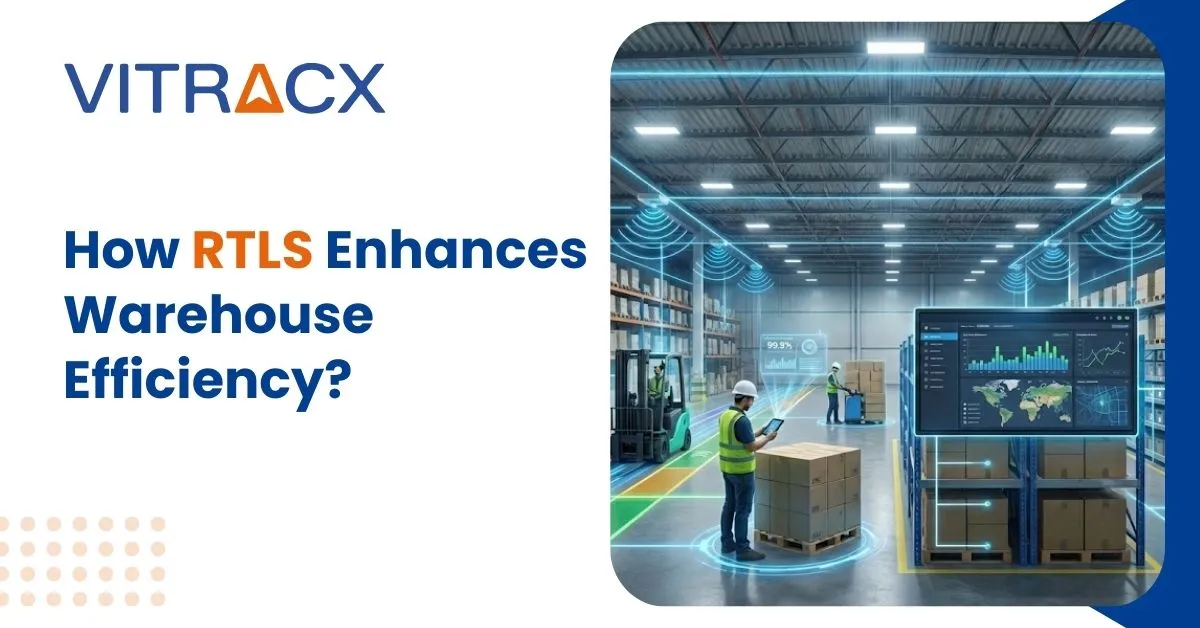
Modern warehouses are under constant pressure to operate faster, smarter, and more accurately. With growing order volumes, complex inventory movement, and rising customer expectations, traditional warehouse management methods often fall short. This is where RTLS (Real-Time Location Systems) play a transformative role.
RTLS enhances warehouse efficiency by providing real-time visibility of assets, equipment, inventory, and workforce movement. By enabling data-driven decision-making, RTLS helps warehouses reduce operational delays, improve accuracy, and increase overall productivity.
What is RTLS and Why It Matters in Warehousing?
RTLS is a technology framework that continuously tracks the real-time location of assets using wireless communication and data processing systems. In warehouses, RTLS improves visibility, eliminates manual tracking, and supports smarter decision-making across inventory management, logistics, and operations.
With RTLS, warehouses gain:
- Real-time asset visibility
- Faster order processing
- Reduced operational errors
- Improved safety and compliance
- Higher productivity and accuracy
How RTLS Works?
A typical RTLS infrastructure is built using four key components:
- RTLS Tags
- RTLS Receivers / Anchors
- Storage & Processing Middleware
- Business Applications & Dashboards
Each component plays a vital role in delivering accurate and real-time location intelligence.
1. RTLS Tags – The Data Source
RTLS tags are small devices attached to assets, equipment, pallets, or personnel. These tags continuously transmit location and identification data at predefined intervals—every second, few seconds, or minutes depending on operational requirements.
Key Features of RTLS Tags
- Transmit ID, location, and timestamp data
- Support additional sensors (temperature, motion, vibration, humidity)
- May include LED indicators for visual identification
- Can include emergency or alert buttons for safety use cases
Battery Types
- Built-in batteries: Lower upfront cost, replaced once depleted
- Replaceable batteries: Longer lifecycle and easier maintenance
Most RTLS systems also provide battery health alerts to prevent unexpected downtime.
2. RTLS Receivers / Anchors – Capturing Location Signals
RTLS receivers (also called anchors) are fixed devices installed across the warehouse. They receive signals from RTLS tags and calculate precise asset positions.
These anchors function similarly to GPS satellites—but operate indoors with far greater accuracy.
Key Characteristics of RTLS Anchors:
- Installed on walls, ceilings, or pillars
- Wired or battery-powered depending on layout
- Form a synchronized network for accurate triangulation
- Support 2D or 3D location tracking
The number of anchors required depends on:
- Warehouse size
- Ceiling height
- Line-of-sight availability
- Desired location accuracy
For example, in optimal conditions, a small number of UWB anchors can cover large warehouse zones with high precision.
3. Storage & Processing Middleware (RTLS Engine)
The middleware is the brain of the RTLS system. It receives raw data from tags and anchors, processes it, and converts it into meaningful location insights.
What the Middleware Does?
- Calculates precise asset positions
- Filters and processes raw signals
- Stores historical tracking data
- Generates alerts and analytics
- Sends data to dashboards and enterprise systems
Deployment Options:
- Cloud-based platforms – scalable, flexible, and easier to manage
- On-premises servers – preferred for data control and compliance
- Edge processing – faster decision-making closer to the source
Many RTLS platforms integrate with enterprise systems such as WMS, ERP, or IoT platforms via APIs.
4. Business Applications & Visualization
This is the user-facing layer of RTLS where actionable insights are delivered.
Common Capabilities Include:
- Live location maps
- Asset movement history
- Zone-based alerts and geofencing
- Utilization and performance analytics
- Maintenance and compliance tracking
These dashboards allow warehouse teams to respond instantly to events, optimize workflows, and improve overall operational efficiency.
Why Warehouse Efficiency Depends on RTLS?
Traditional warehouse management often relies on manual scans, spreadsheets, or delayed system updates. These methods create blind spots that lead to:
- Inventory inaccuracies
- Delayed order fulfillment
- Asset misplacement
- Poor labor productivity
- Increased operational costs
RTLS solves these challenges by offering real-time tracking, automated data collection, and actionable insights that improve every stage of warehouse operations.