Lean manufacturing focuses on eliminating waste, improving productivity, and maximizing operational efficiency. However, many manufacturers…
- Product Guide
- 8 minute read
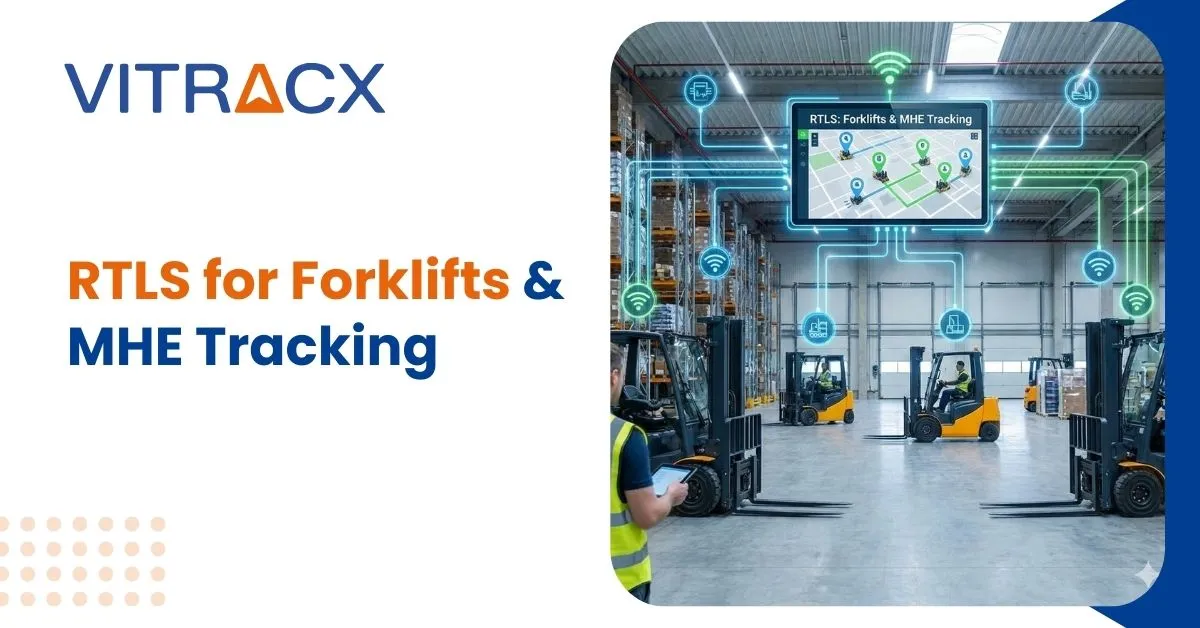
Forklifts and Material Handling Equipment (MHE) are the backbone of warehouse and industrial operations. But when forklift movement isn’t controlled or tracked properly, it leads to avoidable issues like congestion, idle time, damaged goods, safety incidents, and delayed dispatch.
That’s why modern facilities are now adopting RTLS to monitor forklift and MHE activity in real time. With a Real Time Location System, companies can track equipment movement, optimize routes, reduce downtime, and improve safety compliance—without relying on manual reporting.
In this blog, we’ll explore how RTLS improves forklift and MHE tracking, key use cases, benefits, best practices, and how to implement a Real Time Location System for measurable ROI.
What Is RTLS for Forklift and MHE Tracking?
RTLS for forklift and MHE tracking refers to using real-time location technology to monitor forklifts, pallet jacks, reach trucks, tuggers, and other handling equipment inside a facility. A Real Time Location System captures movement data using tags and sensors and displays it on a live dashboard for operational visibility.
Unlike traditional fleet tracking methods, RTLS provides indoor positioning accuracy where GPS cannot work. A Real Time Location System helps operations teams understand exactly where equipment is, where it’s been, how it’s being used, and where inefficiencies exist.
Why Forklift and MHE Tracking Matters in Warehouses?
Most warehouse delays are not caused by lack of labour—but by lack of visibility. When you don’t know which forklift is available or where the nearest pallet is staged, productivity drops instantly. This is where RTLS becomes a game-changer because a Real Time Location System removes the guessing from daily operations.
Common problems that forklift tracking solves include:
- Forklifts spending too much time idle
- Congestion in key warehouse aisles
- Delays in loading/unloading docks
- Inefficient routes and excessive travel distance
- Equipment misuse or unauthorized access
- Higher risk of vehicle-pedestrian incidents
- Poor utilization of the MHE fleet
With RTLS tracking, supervisors make faster decisions because the Real Time Location System shows real-time equipment location and status.
How RTLS Works for Forklift and MHE Tracking?
A typical Real Time Location System setup includes tags placed on forklifts and sensors installed across the facility. The system collects location signals and converts them into actionable tracking insights.
RTLS Tracking Setup
| RTLS Component | Purpose | Example in Forklift Tracking |
| Tags (UWB/BLE/RFID) | Track each forklift | Tag forklifts + pallet jacks |
| Anchors/Sensors | Detect real-time movement | Track route changes in aisles |
| Location Platform | Visualize data on a map | Live dashboard visibility |
| Rules & Alerts | Trigger safety/workflow actions | Proximity warning near pedestrians |
| Analytics & Reports | Identify patterns and gaps | Utilization, idle time reports |
With RTLS, forklift movement becomes measurable, and a Real Time Location System helps facilities optimize operations continuously.
Use Cases of RTLS for Forklift and MHE Tracking
With RTLS, warehouses can monitor every forklift and MHE unit in real time to improve productivity and reduce delays.
A smart Real Time Location System helps track live location, movement patterns, idle time, and task efficiency across all operational zones.
This makes it easier to optimize routes, improve fleet utilization, and enhance overall material handling performance using actionable tracking data.
1) Real-Time Location Tracking of Forklifts
The most basic and valuable use case is knowing where each forklift is—instantly. With RTLS, managers can locate the nearest forklift to a task. A Real Time Location System reduces search time and improves dispatch speed during peak operations.
This is especially useful in large warehouses where equipment availability changes every minute, and task delays directly impact SLAs.
2) Forklift Utilization and Idle Time Monitoring
Many warehouses operate with more forklifts than needed because there’s no accurate utilization data. With RTLS, businesses can measure equipment productivity precisely. A Real Time Location System identifies:
- Idle vs active time
- Overused vs underused forklifts
- High-traffic operational zones
- Bottleneck locations causing wait time
This helps reduce unnecessary fleet costs while maximizing performance.
3) Route Optimization and Congestion Control
Forklifts often take longer routes because operators follow habits rather than optimized paths. With RTLS, route patterns can be analysed. A Real Time Location System shows areas where congestion happens repeatedly and helps redesign traffic flow.
Route optimization benefits include:
- Reduced travel distance
- Faster picking and replenishment
- Less fuel/battery usage
- Lower wear and tear
With RTLS, you also reduce collision risk because the Real Time Location System highlights dangerous traffic intersections.
4) Safety Alerts and Proximity Warnings
Forklift accidents remain one of the biggest hazards in warehouses. With RTLS, proximity alerts can be enabled to warn pedestrians and operators in real time. A Real Time Location System supports:
- Vehicle-to-worker alerts
- Vehicle-to-vehicle collision warnings
- High-risk zone entry detection
- Speed monitoring in critical aisles
This reduces near-miss incidents and improves compliance with safety procedures.
5) MHE Tracking for Pallet Jacks, Tuggers, and Reach Trucks
Forklift tracking is important, but most warehouses also lose productivity due to missing secondary MHE assets. With RTLS, you can track pallet jacks, tuggers, stackers, and hand-operated equipment. A Real Time Location System improves:
- Equipment availability
- Faster task completion
- Reduced time wasted searching
- Better asset accountability
This is especially valuable in high-density warehouses where shared equipment frequently goes missing.
6) Maintenance Planning and Equipment Health Support
While RTLS doesn’t replace maintenance systems, it supports better planning by tracking usage hours, high-stress zones, and repetitive patterns. A Real Time Location System can help teams schedule preventive maintenance more intelligently based on real activity rather than assumptions.
This reduces breakdowns during peak work hours and improves equipment life cycle performance.

Are you ready to improve forklift safety and reduce idle time with RTLS? Contact us today for real-time forklift and MHE tracking.
Benefits of RTLS for Forklift and MHE Tracking
When implemented properly, RTLS delivers measurable improvements in safety and productivity. A Real Time Location System also helps reduce unnecessary costs by optimizing fleet operations.
| Benefit | Business Impact |
| Faster task assignment | Forklifts are located instantly |
| Reduced idle time | Higher utilization and productivity |
| Route optimization | Less travel time and congestion |
| Improved safety | Proximity alerts reduce collisions |
| Lower equipment loss | MHE accountability improves |
| Better reporting | Automated dashboards for audits |
| Reduced operational cost | Smarter fleet size planning |
With RTLS, operations become data-driven, and the Real Time Location System supports continuous improvement.
Industries That Benefit Most from Forklift and MHE Tracking
Many industries rely on forklifts daily, which makes RTLS tracking a high-ROI investment. A Real Time Location System is especially useful in environments with heavy movement and time-sensitive tasks.
Common industries include:
- Warehousing & distribution
- Manufacturing plants
- Cold storage and food logistics
- Retail fulfilment centres
- Automotive and spare parts warehouses
- Ports, yards, and industrial campuses
Wherever forklift movement impacts delivery speed, RTLS helps improve efficiency through real-time tracking.
Best Practices for RTLS Forklift Tracking Implementation
A successful Real Time Location System deployment depends on using tracking data for real operational decisions—not just visibility.
Implementation Checklist
- Start with high-use forklifts first (top 20% fleet)
- Define tracking zones (docks, aisles, staging, charging areas)
- Configure meaningful alerts (avoid excessive notifications)
- Use dashboards for supervisors and dispatch teams
- Review weekly reports for idle time and congestion hotspots
- Improve traffic layout based on movement data
When RTLS is aligned with workflow goals, the Real Time Location System delivers faster ROI.
Frequently Asked Questions
RTLS forklift tracking monitors indoor forklift movement in real time. A Real Time Location System displays location, routes, and activity trends for better control.
Yes. RTLS enables proximity alerts and restricted zone warnings. A Real Time Location System helps reduce collisions and near-miss incidents.
A Real Time Location System tracks active and idle movement patterns. With RTLS, managers can identify delays and optimize dispatch allocation.
Yes. RTLS supports multiple asset types, and a Real Time Location System helps locate shared MHE quickly to avoid delays.
Not exactly. RTLS complements WMS by providing real-time location data. A Real Time Location System improves tracking accuracy and workflow visibility.
Conclusion
Forklifts and MHE directly impact warehouse speed, safety, and cost. Without real-time visibility, operations face avoidable delays, congestion, and higher safety risks. That’s why RTLS is becoming essential for material handling optimization. A Real Time Location System helps you track movement, reduce idle time, improve routes, and create safer warehouse workflows.
Forklift TrackingForklift Tracking And Monitoring SystemForklift Tracking In WarehouseGps For Tool TrackingTool Tracking SystemsWarehouse Forklift Tracking